Chicago and Daytona Beach sit at opposite ends of the American climate spectrum. Chicago homeowners dread January pipe bursts and March snowmelt floods. Daytona Beach homeowners track the Atlantic hurricane season from June through November. Despite being separated by 1,300 miles and two completely different climates, both cities produce serious, recurring water damage events that require fast professional response.
What changes between them is not the urgency – it is the season, the source, the building materials at risk, and the secondary damage timeline. Understanding those differences helps homeowners in both markets respond smarter when water intrudes.
Chicago’s Water Damage Calendar
Water damage in Chicago follows a predictable seasonal cycle that local restoration professionals know well.
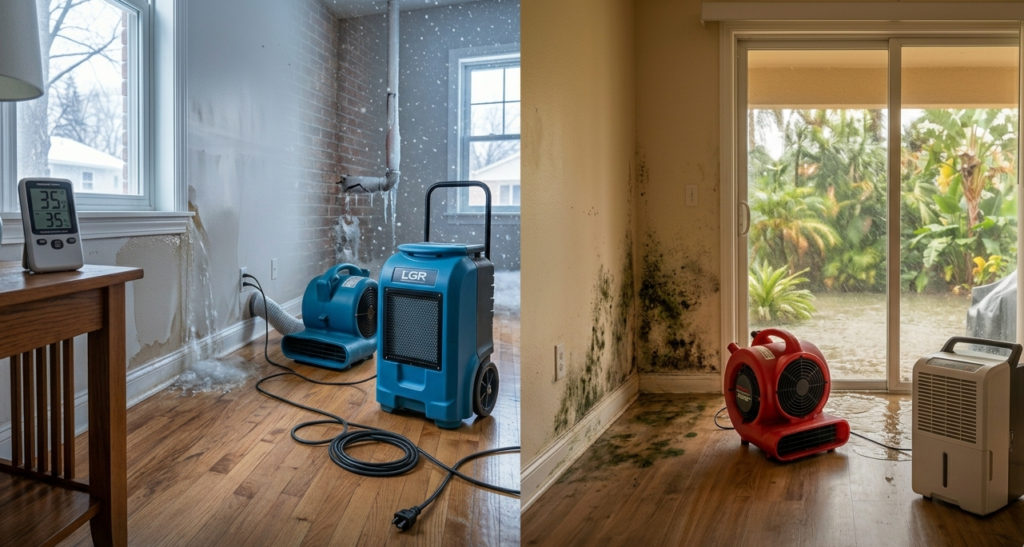
Winter (December–February): Pipe failures and ice dams Sustained below-freezing temperatures stress supply lines in exterior walls, unheated crawl spaces, and attic pipe runs. When temperatures swing above freezing – often briefly during a January thaw – frozen pipes burst and release full line pressure into the structure. A burst pipe discovered at 7am that failed at 2am has typically released 600–4,000 gallons depending on pipe diameter.
Ice dam formation on Chicago’s older building stock – particularly the flat and low-slope roofs common on greystones and two-flats – traps meltwater behind ice barriers at drains and gutters, forcing water back under roofing membranes and into ceiling assemblies.
Spring (March–May): Snowmelt basement flooding Chicago’s clay-heavy soils drain poorly, and spring snowmelt events can saturate the ground faster than it can absorb or drain. Hydrostatic pressure against basement walls builds rapidly, pushing water through mortar joints, floor slab cracks, and window well gaps. Combined sewer overflow events – where the aging Chicago combined sewer system routes both stormwater and sewage through shared pipes – produce Category 3 (black water) contamination in basement floor drains during heavy melt events.
Summer (June–August): Thunderstorm flooding Chicago’s summer storm season produces intense, short-duration rainfall events that overwhelm urban drainage systems quickly. Flash flooding in low-lying neighbourhoods and basement flooding from overwhelmed sump pumps are the dominant summer events.
Daytona Beach’s Water Damage Calendar
Florida’s water damage season runs on an entirely different clock – one driven by the Atlantic hurricane season and subtropical humidity.
Hurricane season (June–November): Storm surge and wind-driven rain Daytona Beach sits on Florida’s northeastern Atlantic coast, directly exposed to tropical systems tracking up from the Caribbean and Gulf. A direct hurricane landfall or even a near-miss can deliver storm surge of 3–8 feet into low-lying coastal and near-coastal properties, combined with wind-driven rain penetrating every building envelope gap simultaneously.
The damage from a hurricane water event is multi-source and multi-category simultaneously: Category 1 clean water from roof intrusion, Category 2 grey water from overwhelmed drainage, and Category 3 contaminated water from storm surge that has contacted soil, marine organisms, and sewage systems- all in the same structure at the same time.
For Volusia County homeowners, certified specialists in Daytona Beach water damage restoration are structured for exactly this multi-source scenario – with protocols that address each water category separately and restoration timelines built around Florida’s compressed mold initiation window.
Dry season (December–May): Plumbing failures and AC condensate Florida’s “off season” for hurricanes is not an off season for water damage. Aging plumbing in Florida’s older housing stock fails year-round. Air conditioning condensate line clogs – extremely common in Florida’s high-use AC environment – overflow into wall cavities and ceiling assemblies silently, producing hidden mold growth that homeowners discover months after the event.
The Mold Window: Chicago’s 48 Hours vs. Daytona’s 24 Hours
The single most important difference between Chicago and Daytona Beach water damage is the mold initiation timeline.
In Chicago, winter water events occur in structures that are heated but not humid. Ambient relative humidity in a Chicago home in January runs 20–35%. This gives restoration professionals a 48–72 hour window before mold colonisation begins in wet materials – enough time for a same-day response team to extract and deploy drying equipment before secondary damage compounds the primary loss.
In Daytona Beach, ambient humidity runs 70–85% year-round. A water event in a subtropical Florida home creates near-perfect mold germination conditions immediately. The mold initiation window compresses to 24 hours or less – and in the peak of summer, visible mold growth can appear in unaddressed wet materials within 48–72 hours of the event.
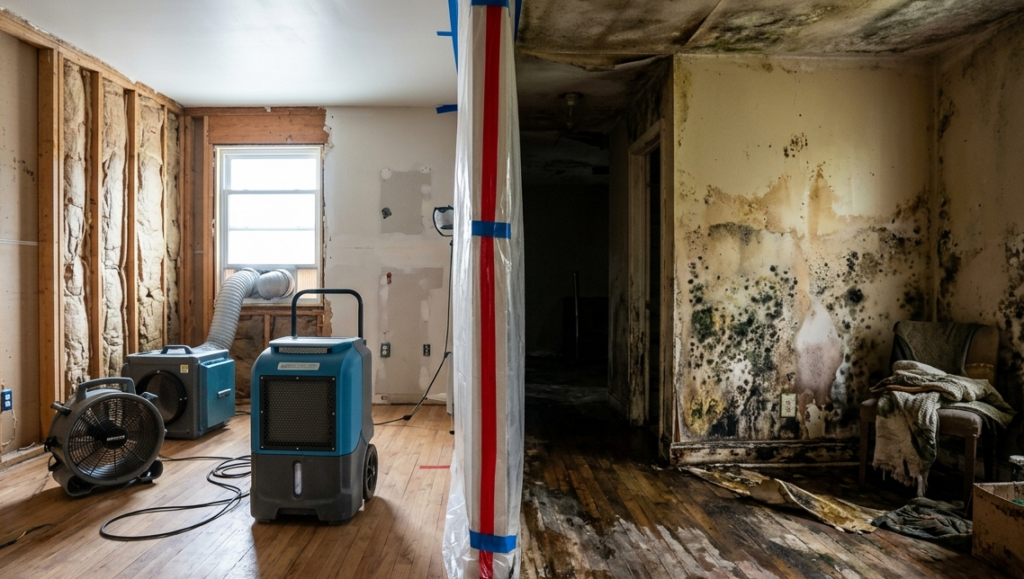
This is why Florida restoration companies invest in faster dispatch infrastructure than most northern markets require. Speed is not a customer service feature in Daytona Beach – it is a technical necessity driven by the climate.
Building Materials: What Gets Damaged and How
Chicago and Daytona Beach also differ significantly in their dominant construction types, which affects what gets damaged and what the restoration scope looks like.
Chicago:
- Wood-frame construction with brick or vinyl exterior cladding dominates the residential market
- Basement construction is near-universal – the frost line requires foundations below 42 inches, making basements a standard feature
- Older greystones and two-flats contain lath-and-plaster walls that absorb and release moisture differently from modern drywall
- Pre-1978 construction frequently contains lead paint; pre-1980 construction may contain asbestos in floor tile, pipe wrap, and ceiling texture
Daytona Beach:
- Concrete block (CBS) construction is common throughout Volusia County – blocks absorb water into the masonry itself, requiring drying cycle extensions of 2–3x what wood-frame structures need
- Slab-on-grade construction eliminates the basement but creates under-slab plumbing vulnerability and slab-leak risk
- Stucco exterior systems can trap moisture behind the finish coat when flashing and weep screed systems fail
- Florida’s high UV and humidity environment degrades roofing materials, window seals, and caulking faster than northern climates
The IICRC Standard: What Both Markets Share
Despite these differences, the professional baseline for water damage restoration is identical in Chicago and Daytona Beach. The IICRC S500 Standard for Professional Water Damage Restoration sets drying goals, documentation requirements, moisture content targets for each material class, and protocols for contamination category assessment.
Any restoration contractor in either market should be IICRC-certified and able to provide daily drying logs and a final moisture clearance certificate. These documents protect your insurance claim and ensure the restoration was completed to an objective standard – not just until things look dry.
For insurance, homeowners in both Chicago and Daytona Beach should review their declarations pages carefully. Standard homeowners policies do not cover groundwater flooding in either state. Illinois homeowners need a water backup endorsement for sewer overflow events. Florida homeowners in flood-zone-adjacent properties need a separate NFIP policy through FEMA’s National Flood Insurance Program for storm surge coverage.
Conclusion
Chicago winters and Daytona Beach hurricane seasons are about as different as American weather gets. But the homeowners who fare best in both markets share one approach: act within the first two hours, document before touching anything, and hire certified professionals who understand their region’s specific failure patterns. The season changes. The fundamentals do not.
IL Water Damage Restoration Pros serves Chicago, IL and surrounding communities with 24/7 emergency response, flood extraction, structural drying, mold remediation, and sewage cleanup. IICRC-certified. Licensed and insured.
Call: (312) 815-4144
Leave a Reply